
Introduction
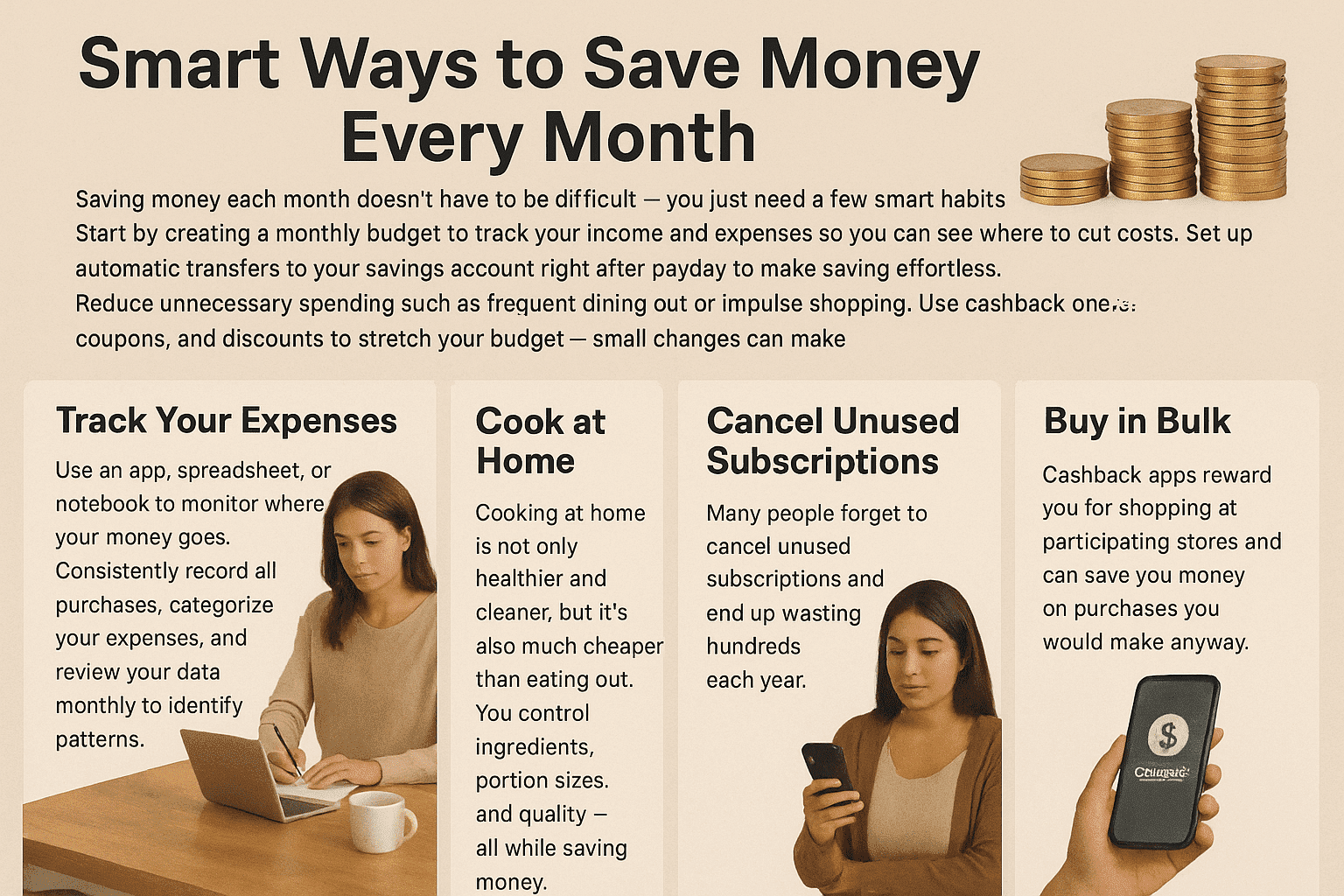
If you use some clever techniques, saving money each month doesn’t have to be hard. Making a monthly budget that keeps track of your earnings and outlays and helps you find areas where you can cut costs is one smart tactic.
To help you save before you spend, you should also set up automatic transfers to your savings account as soon as you receive your paycheck.
Cutting back on wasteful spending, like eating out frequently or shopping on the spur of the moment, can also have a significant impact. Another way to save money when you shop is to use cashback offers, coupons, and discounts.
Lastly, you can save even more money by going over your subscriptions and cancelling those you don’t use frequently.
Track Expenses
Use an app, spreadsheet, or notebook to keep track of your spending, depending on your spending patterns and financial constraints. To improve your financial habits, it’s important to consistently record all of your purchases, classify your spending, and periodically review your data.
Techniques for monitoring spending Apps for tracking expenses How it operates: Numerous apps automatically track and classify your spending by connecting to your bank and credit card accounts.
The most effective way to enhance your financial situation involves developing the expense tracking habit. The majority of people fail to accumulate savings because they lack knowledge about their spending patterns. Daily expenses which include coffee and snacks and online subscriptions appear to be minor costs but they accumulate to become a substantial part of your monthly earnings. The process of expense tracking allows you to understand your financial behavior while achieving better control over your spending.
The first step requires you to document every financial transaction including the smallest expenditures. You can track your expenses through various methods which include using a notebook or spreadsheet or budgeting app or your bank’s mobile application. Your spending should be divided into different categories which include housing expenses and transportation costs and grocery purchases and entertainment expenses and utility payments and personal spending. The process enables you to identify your spending patterns together with the specific areas where you tend to spend more money.
You need to check your expenses at the conclusion of each week or month. You need to compare your actual spending with your budgeted amounts. Are you eating out more often than you had originally planned for your budget? Are subscription services taking a bigger share than expected? Regular reviews help you adjust before small problems become major financial setbacks.
Through expense tracking we establish our ability to create achievable financial objectives. The knowledge of your spending patterns allows you to determine your monthly saving capacity. The process of identifying unneeded expenditures becomes simpler because you can use the saved funds for savings or investments or debt repayment.
The process of tracking expenses establishes financial awareness as the primary result. The process of documenting every expenditure makes you aware of your spending choices throughout the day. Your awareness of your financial habits will develop into better spending decisions together with effective budgeting skills and improved money management abilities. You need to track your expenses every day because this will help you achieve financial stabilization.
Cash purchases can also be manually added. Advantages: incredibly practical, offers visual spending summaries, real-time insights, and the ability to set reminders to keep you within your spending limit.
Cook at Home
It’s a good habit to cook at home. It enables us to consume wholesome, fresh food. We are aware of the ingredients we use when we cook at home.
Food prepared at home is safer and cleaner than food from the store. In addition, it saves money and strengthens family bonds. Another practical life skill that everyone should acquire is cooking.
The most convenient method of reducing monthly expenses requires you to prepare your meals at home. The habit of dining at restaurants and ordering delivery or choosing quick-service restaurants leads to higher expenses than cooking your own meals at home. When you prepare your meals at home, you gain total authority over your food ingredients and meal sizes and your total expense.
The process of meal planning needs to be done beforehand so you can achieve better results. Create a weekly meal plan and grocery list before going shopping. The system helps you prevent buying unplanned items while it helps you decrease the amount of food that gets thrown away. Your grocery expenses will decrease when you buy items in bulk and select seasonal products while you follow your shopping list. Home cooking enables you to transform leftover food into new dishes which help your finances last throughout the week.
Home cooking enables people to save money while they prepare healthier meals. You can decrease your intake of harmful salt and sugar and unhealthy fats while increasing your consumption of fresh vegetables and whole foods. Better nutrition results in lower healthcare expenses throughout the years.
Home cooking provides essential life skills while promoting people to spend their money wisely. The practice of cooking additional meals at home each week results in both financial savings and increased financial security.
It can also be imaginative and enjoyable!
Cancel Subscriptions
This is often the easiest way to end the agreement and ensure that you won’t be charged by the company again Locate your account: Open the company’s website or app and log in.
Find the settings: Navigate to the area where you can manage your account settings, payment details, or subscriptions.
Do the following: Locate a “Cancel Subscription,” “Manage Plan,” or comparable option, and then adhere to the instructions.
The process of cancelling all subscriptions which are not needed leads to immediate monthly savings for which people do not need to spend time or effort. People make purchases of streaming services and fitness applications and cloud storage solutions and premium subscriptions which they later forget about. The automatic charges which occur at small amounts create a situation where they remain invisible until three months have passed. The two groups together create a dangerous solution which eliminates most of your earnings.
You need to start your process by checking your bank statements and credit card records to find all your automatic payments. You should create a collection of all current subscriptions and evaluate which ones you actually utilize and appreciate. If you haven’t used a service in the past month or two, consider canceling or pausing it. You will have the option to resubscribe at any future time when you need to access the service again.
The practice of substituting one subscription with another presents a useful method for customers to use their services. Users should first select one streaming service and maintain their subscription until they finish watching all content before switching to a different service. This method enables people to experience various entertainment options while maintaining their budgetary requirements.
The practice of cancelling subscriptions which cost between 10 and 30 dollars monthly leads to annual savings which exceed 100 dollars. You will improve your financial situation when you redirect those funds toward savings or investments which require almost no effort from you.
Check and save: After cancelling, save any screenshots or emails you receive confirming your cancellation.
You may still be able to use the service until the end of your current billing period.
Buy in Bulk
Retail bulk stores are the most convenient choice for domestic or personal use.
Warehouse clubs: To gain access to discounted bulk items, such as food, household goods, and electronics, stores like Costco and Sam’s Club demand an annual membership.
Retail establishments: Bigger supermarkets, such as Walmart, also provide bulk options, particularly for paper and food items that are shelf-stable.
Online marketplaces: Azure Standard is a well-known online bulk food retailer that serves buying clubs and ships to many locations in the United States.
Use Cashback Apps
By registering and linking your cards, you can use cashback apps to save money. Then, when you shop through the app or at participating stores, you can earn rewards or cash back on regular purchases.
While some apps function passively by tracking transactions or sending you to stores via their platform, others require you to add offers or scan receipts.
Using cashback apps is a smart and simple way to save money on everyday purchases. The apps provide you with cash back rewards that equal a percentage of your spending when you make purchases through their platform or upload receipts. The initial savings may appear minor, but they will accumulate substantial value when you maintain regular usage of the service.
Cashback apps typically partner with retailers, grocery stores, restaurants, and online shops. Before making a purchase, check the app to see if the store is offering cashback. Some apps provide online shopping rewards through special links, while other apps offer cashback when customers scan their receipts from in-store purchases. Many also offer bonus promotions or special deals for certain products.
You can achieve maximum savings when you use cashback offers together with coupons and discount codes and sales. This stacking strategy enables you to decrease your total cost while you continue to receive money back from your purchase. However, it’s important to avoid spending just to earn rewards. You should only buy things that you actually need.
The money that you earn through cashback apps will be available for transfer to your bank account or PayPal account or as gift card redemption. Cashback apps create savings opportunities through normal spending when users apply these apps wisely to their expenses.
After that, you can exchange your profits for money, gift cards, or other incentives.
Save First Rule
The “Save First” rule, sometimes referred to as “Pay Yourself First,” is the principle that you should save a portion of your income before using it for other purposes.
One common rule is the 50/30/20 rule, which states that you should set aside 50% of your post-tax income for necessities, 30% for wants, and 20% for debt repayment and savings.
An alternative approach is the 80/20 rule, which states that you should save 20% of your income first and use the remaining 80% for all other expenses.
You can also check out this post:
10 Common Financial Mistakes to Avoid
How to Plan a Monthly Budget Easily
Best Online Banks for Savings in 2025
How to Build an Emergency Fund in 6 Months
Conclusion
Budgeting isn’t rocket science, but it’s a lot of planning and discipline.
For example, cancelling subscriptions, buying in bulk, using cashback apps, and adhering to the “Save First Rule” are all important.
It’s also crucial to have simple and sustainable lifestyle choices.
Chhoti chhoti aadatein hi bade farq laati hain—aur jab ye aadatein aapki life ka hissa ban jaati hain, to aap apne goals ke kareeb pahunch jaate ho bina stress ke.
Toh aaj se hi ek chhota step lo, apne paise ko samjho, aur apni financial journey ko intelligent aur self-assured banayo!
FAQs
Q1: Why is budgeting important for monthly savings?
Budgeting helps you understand where your money goes, identify unnecessary expenses, and plan how much to save. Without a budget, it’s easy to overspend without realizing it.
Q2: How does “paying yourself first” work?
This means automatically transferring a set amount to savings as soon as you receive your income. By prioritizing savings before spending, you make it consistent and effortless.
Q3: How can canceling subscriptions save money?
Many subscriptions go unused or forgotten. Reviewing and canceling unnecessary services—like streaming platforms or apps—can free up hundreds of dollars annually.
Q4: Why is cooking at home more cost-effective than eating out?
Eating out is often much more expensive than preparing meals at home. Cooking allows portion control, reduces waste, and helps you buy ingredients in bulk for long-term savings.
[…] 6 Smart Ways to Save Money Every Month […]